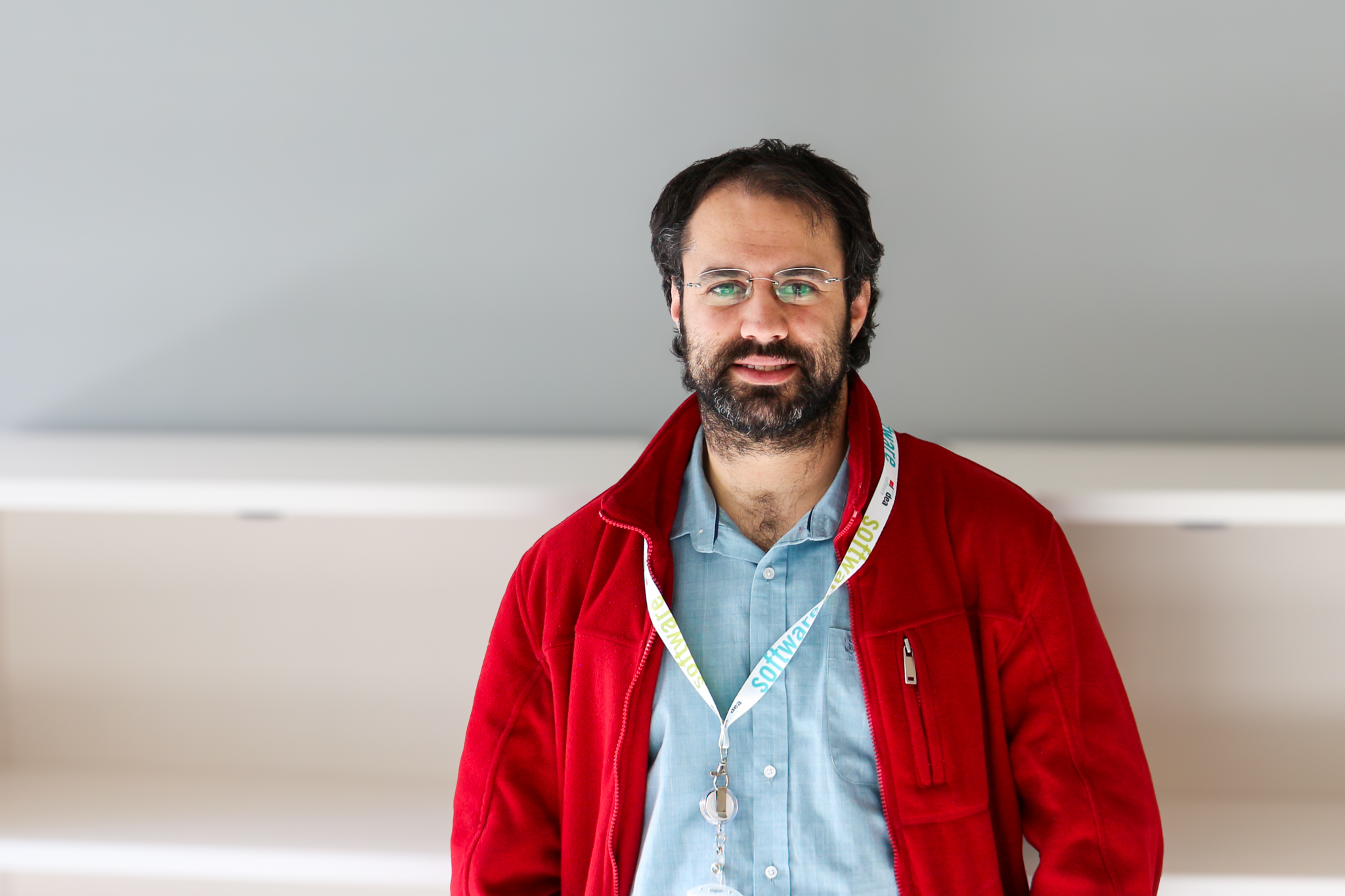
David Martínez Rubio is the new PhD researcher who joined IMDEA Software in 2026. He was trained in Mathematics and Computer Science, completing both bachelor’s and master’s degrees before earning his PhD at the University of Oxford. After his doctorate, he continued his research career in Berlin with a postdoctoral position funded by a MATH+ project, where he worked on optimization for machine learning with Sebastian Pokutta and the IOL group. He was awarded a Juan de la Cierva fellowship at Universidad Carlos III de Madrid, and later received the Junior Leader fellowship from La Caixa.
His research spans several areas within machine learning, with a primary focus on continuous optimization and its connections to fields such as online learning and machine learning theory, particularly in high-dimensional problems.
Outside academia, he enjoys climbing and designing and playing games that pose interesting challenges, a hobby that fits perfectly with his taste for complex problems.
You have been awarded a Obra Social la Caixa for your project “Accelerated optimization methods for machine learning: speed and adaptivity”. Could you explain what your research will focus on?
The project consists of making use of and developing new tools within the fields of online learning and optimization in order to develop new fast optimization algorithms for high-dimensional tasks in machine learning and network analysis, with guarantees. Some of these tasks are PageRank, Riemannian optimization, continuous packing problems like fair resource allocation, high-order accelerated methods, and most importantly: achieving hyperparameter adaptivity of a range of optimization algorithms for machine learning. Machine learning optimization suffers greatly from hyperparameter search, and it is essential to develop tools to automatically and efficiently adapt to these unknown parameters. This project includes some research money that I will mainly use to hire one PhD student. Besides, I hope I can establish some collaborations within IMDEA Software: machine learning and optimization have a broad range of applications, and also does online learning.
What impact do you think your results will have on society?
Developing efficient optimization algorithms will allow for performing more artificial intelligence tasks, faster, and using less energy. There is currently a huge demand for better and faster systems that work efficiently in the high-dimensional world of our data-centric technology.
A large part of your research career has taken place abroad. What does returning to Spain mean to you?
I spent 8 years abroad doing research and I am very happy being back in Spain. It’s a pleasure to be in your own country, specially being able to do the research I like. It also opens up a window for me to collaborate with all the people here and contribute to building and maintaining the scientific system that once trained me.
Profiles like yours are highly sought after in the corporate world. What motivates you to continue doing research?
I like my research field and I really appreciate the intellectual freedom to explore the problems that one considers important and within reach.
Finally, what advice would you give to university students who are considering a career in research?
You have to like it a lot. Pursuing a research career is a very competitive path and a difficult one to follow. It requires some sacrifice, but it is very rewarding. Choosing who will supervise your research at the initial stages is very important. Being able to work independently is essential.
From our institute, we extend a warm welcome to David and wish him a stay that is as productive as it is enjoyable.
The research that has made possible these results has been partially boosted by Obra Social “la Caixa”